
Orogeny
time & its materials

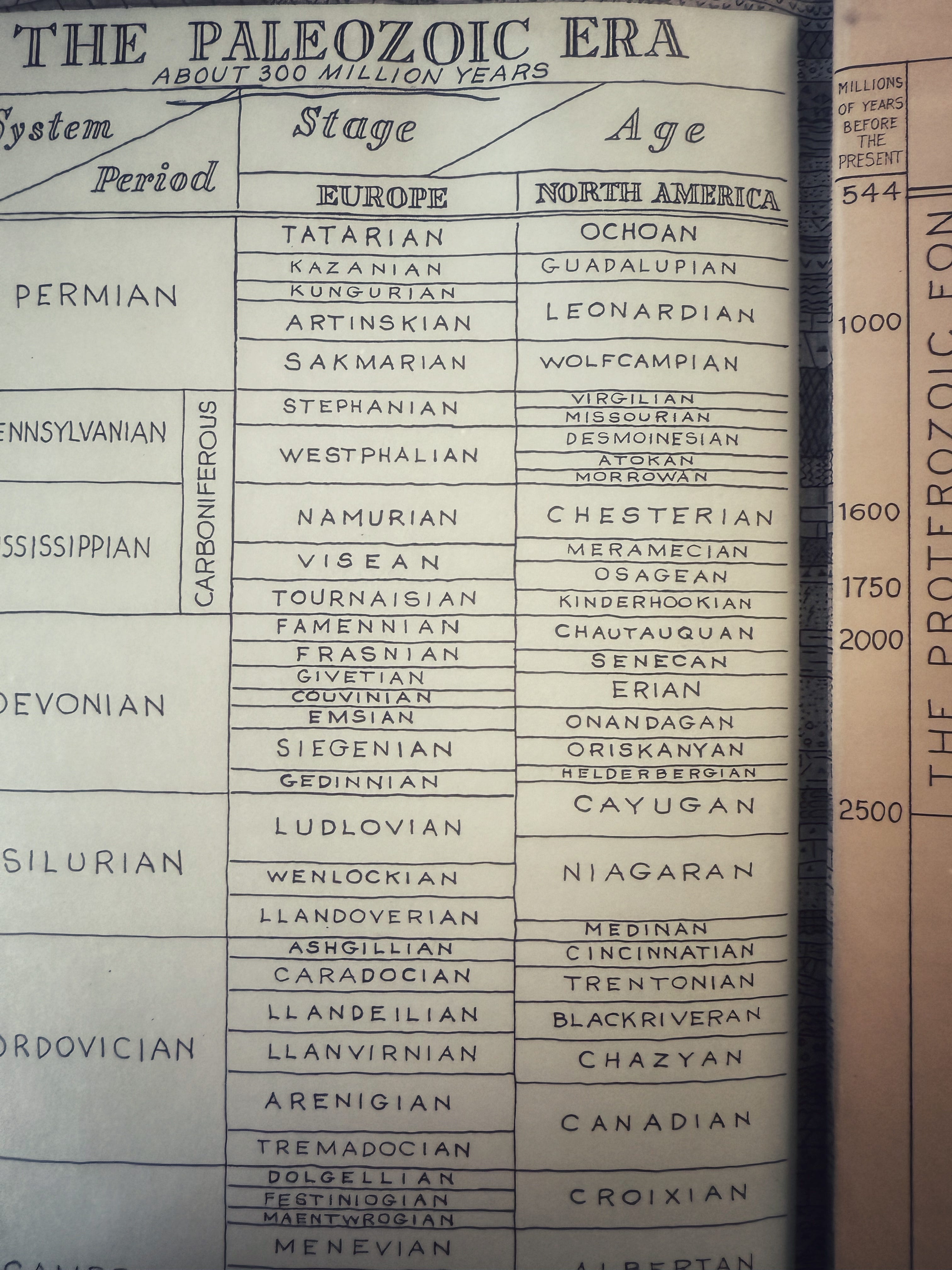
At one time, it was so quiet that I imagine the sun must have droned a dull melody onto the surface of the shallow sea. Twenty degrees south of the equator, Appalachia’s fertile valleys and rocky ridges were a gauzy dream yet to crystalize into granule quartzite and limestone. Where I stand now at my doorway looking out into bright, cold sunlight, trilobites and gastropods once scuttled at the bottom of the shallow, warm, coastal dip into the ancient Iapetus Ocean. I imagine my mug of tea sinking to the bottom; my books, waterlogged and spreading their fins, ink mixing with water, and succumbing to the enormity of sea, of time.
I commute to work, following a long, 325 million-year-old Appalachian ridge, and then another. I drive for 35 minutes. I work for 10+ hours on a 485 million-year-old formation of dolostone, helping people who hate, and want to end, their lives. Where I sit and empathize with the money-broke, medicine-broke, love-broke, spirit-broke humas, crinoids once unfurled their palmate, calcium-carbonate tendrils in warm water. The nothingness and zeroness of peoples’ lives amass into numbers on a screen and minutes into units of time spent. I make x amount of money per hour. An extra x per week when I’m on-call. I live in a two-income household with my husband. I work a second job once a week. We are childless and frugal. We pursue cheap hobbies of observation and wonder, of putting things in the ground to watch them grow, of looking up to watch the billions of questions light up in the night sky. We live cheaply and then more cheaply as prices rise and rise. We live in a modest, 136-year-old house. We live in a fossil. We live in a timeline where both folks living in a household must not only work degree-earned jobs, but also save.
Laurentia. 2 billion years ago, long before the idea of naming or counting, microcontinents collided, forming a mass of land. Deep time prevents Laurentia or its memory from coming up casually at the dinner table, in our storytelling, or in our music. Most folks scowling at the price of fruit in the produce section have never heard of Laurentia. Most folks scrolling on their phones while filling their gas tanks with chemicals that derive from ancient lifeforms have never heard of Pangea, the landmass formed when Laurentia collided with Gondwana (Africa). Where I live, when the folks at the gas pumps look up from their phones, they see a wall of rock and trees and topsoil in one direction and the other. One of them is a ridge from that enormous collision, called an orogeny, or the genesis of a mountain. The other is a steep edge of a plateau (called an escarpment) that is called the Allegheny Front. The land east of the Allegheny Front is called the Ridges & Valleys, that splays out across Pennsylvania like a rippling rug. Our earth tells the story of many orogenies. The landscape in which I currently write, wonder, love, and scowl was formed during the Alleghenian Orogeny, about 325 million years ago.
To learn and wonder about deep time is to encounter an immensity of numbers. Our planetary time is accounted for in the millions and billions. Rocks and oceans are hefts of enormous, mind-unraveling weight. To wrap your mind in deep time is to steep your mind in impossible numbers. The culture in which we live introduces numbers in thresholds. The tepid tide of most salaries is in the tens of thousands. The lukewarm tide of some salaries is in the hundreds of thousands of dollars. We can fathom the millions and even the hundreds of millions. The lottery leads us to entertaining the fantasy of hundreds of millions of dollars. And over the last several years, the b-word is everywhere, in the news, in the lottery, in the costs, in the deficits, in the population. We’re entering a time where billion is becoming smaller and smaller. I will never pretend to be good at math. I still count on my fingers when tallying the scores for Phase 10. A million is still a lot to me, in quality and quantity. Millions is both a fantasy and a dinosaur. My friend—the local river—is 300 million years old. 80 is my old friend Arlene. Yet 80 is cheap at the grocery store. My dogs’ ancestors are as old as the salary of my first job. I struggle to comprehend a billion. To make a billion dollars, I must work for 18,518 years. The last ice age was 18,000 years ago. 18,000 years ago, we created advanced stone tools and began to occupy new areas. If I started earning my salary back when the wooly mammoth and mastodon roamed the earth, I’d be just a one-billionaire by now.
Money is in the name, of course. In the 1700s, the very wealthy theologian William Penn founded his sylvan landscape of rolling, fertile hills, the lower piedmont, and the plateau. Many others have set foot on it first, but money, ties, and resources move mountains. The Penn family hired land surveyors Charles Mason and Jeremiah Dixon to survey the land. It is their namesake line that divided the free states from the slave states. They encountered bewildered, violent natives who already knew the hills and water as kith and kin. Leave it to rich, white men to quarter off, cordon, or make demands of the earth. Leave it to rich, white men to fell timber and deprive animals of their habitat and landscapes of their topsoil. Invasive species that they are, humans also devastate the same ecosystems in which they thrive.
There are humans on this planet who can afford a dollar for every year of our earth’s becoming. There are humans who can afford a dollar for every year of a tree’s evolution. There are men who can afford a dollar for every year it took for an owl’s feathers to evolve into silence. The richest person on the planet can afford 200 of our earth’s lifetimes. That’s 900 billion years. That’s older than the oldest known black hole in space (by 887 billion years). A billion dollars could suddenly disappear into that black hole and the richest man in the world will still be the richest man in the world.
Like numbers and deep time, humans are also becoming incomprehensible. “The horrors persist,” they say, but so does everything else. An accumulation. An amalgamation. The ads, the dopamine, the vitriol, the misinformation. The building and building of one’s algorithm contributes to the orogeny of self and me-ness, sometimes to the point of skyrocketing pathology and symptomology. One surrounds themselves with what only reflects what they approve or tolerate, all others be damned. But they damn themselves as well. The orogeny of discontent and intolerance ripples like ridges across the landscape. Like visiting an exposed outcrop of rock that tells the story of deep time, the layers in a landfill tell the story of our desires and discards. Landfill experts will eventually see the Labubu layer, the Stanley Thermos layer, much like how they saw the Lean Cuisine and VHS tape layers. Geologists are already seeing what they call plastiglomerates, or rocks and sand that glom together with melted plastic.
And time, it gloms together and gets lost as we scroll and contribute to the hivemind of reactivity, fueled by the limited economy of our attention. Attention—which is a form of love—is our limited, sacred currency. In these times of us—called The Anthropocene—our attention is pulled and stretched across the infinite landscapes of time, earth, and the largest world-building event on the planet: the Internet. The amount of time that exists on the internet, whether it’s the amount of views that a child’s unboxing video accumulates or the amount of time spent being a keyboard warrior, is astronomical. One simple article written by my weather journalist husband receives, on average, about 76,000 minutes of viewing. That’s almost 53 days. The internet, with the onslaught of AI as entertainment, colleague, therapist, problem-solver, deep-fake, and more, is at risk of becoming a nullscape. At one time, the internet was a landscape we explored to escape reality. Now reality is slowly becoming the escape of the internet as it is overtaken by lawless misinformation, propaganda, and hivemind detriment. The Dead Internet Theory becomes more and more viable.
Time accumulates and erodes as we spread ourselves thin over work, people who don’t deserve our energy, constant complaints, addictions, and pettiness. Those who step out of Kronos (clock-time) and into Kairos (earth-time) may find that time slows and stills like a warm, shallow sea. Here, when you pay the currency of your limited attention, you will feel how the sun shines down on your face. With your valuable attention, you will notice that the waters are warm and the creatures, they just do their business of making the first pathways on this earth. Please do them no harm. And look at those clouds. Look at how they come undone in their becoming. Soon enough, as always, and forevermore, something big will happen, with or without you. It is all a continuous happening. A continuous genesis of building a becoming and initiating an ending. All of us. Every one. And all the ones after.
Come with me, will you, and stay encouraged. Just search for me and you’ll surely find me. I stop somewhere there, waiting for you.
*The last line of this essay is a paraphrase of Walt Whitman’s ending to his poem “Song of Myself”.