

“Now it has become beyond doubt or question their place, and they have become its people. They have given their lives into it, and it has lived in their lives.” – Wendell Berry, The Art of Loading Brush
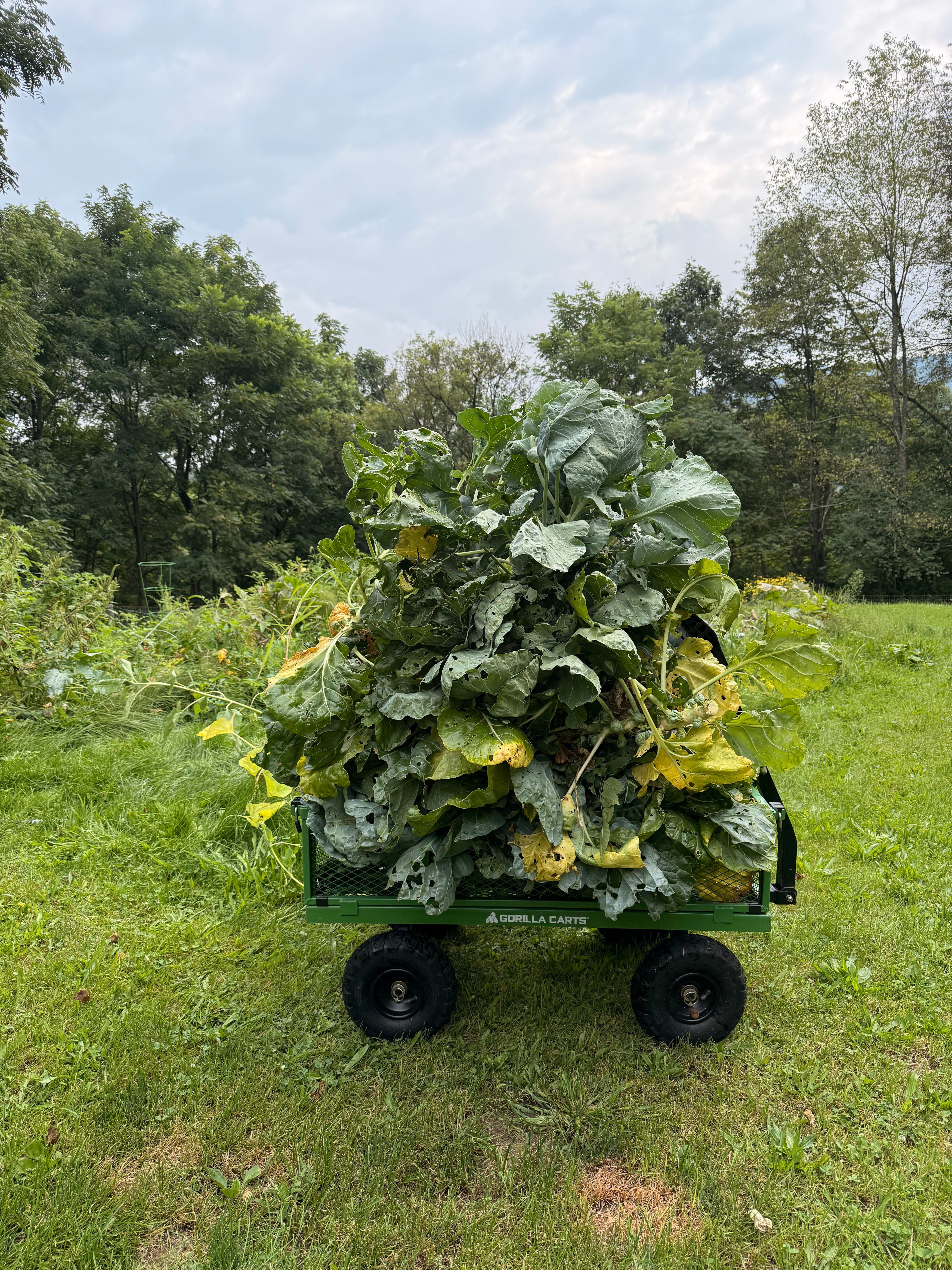
Our large kitchen knife wouldn’t do so I walked to the other side of the house and got the loppers from the shed. One, two, three, four, five, eight pillars of brussels sprouts collapsed into the garden’s lush vine-and-leaf, stalk-and-stem abundance. Eventually, I stacked them into a mound in the green wagon, the mound’s stratigraphy displaying the months of our imagination, labor, and attention.
They looked like peppercorn in the palm of my hand as I stood in the basement in early spring after tearing open a packet of seeds. One at a time I dropped one into a divot of dirt, the fluorescent light above me illuminating the tables of planting trays. Once about a dozen divots were filled, I picked up a tongue depressor labeled “B Sprouts” and used it to cover the tiny seeds with the starter soil comprised mostly of sphagnum peat moss and coconut coir. I plucked the tongue depressor into the soil where it labeled its rows. And then I continued on with the rest of my seeds, poking little packets of hope into the soil, imagining them into being. Imagining the small beads of water from my spray bottle finally settling into the surface of the airy soil. Imagining the water breaking down into the small channels that lead to the seed. Imagining the seed swelling in darkness, the faint speckles of growth light peaking through to it. Imagining the seed coat cracking to release a radicle root.
The writer Wendell Berry often talked about how imagination is required in order to have hope. To imagine is to see a way. “For humans to have a responsible relationship to the world, they must imagine their places in it.” When the tiny first leaves arrived after a few weeks, I continued the routine of light and water. The work of beckoning growth was not complete. Meanwhile, the soil outside grew soft with spring’s warmth and rains, so I turned it with my hands. Into the soil, I placed worms I have also grown and fostered over the past couple of years. Eventually, the ceremony of carrying the trays up the basement steps arrived and the seedlings saw sun for the first time. They learned outside. They learned wind.
And the weeks have gone by of one dog chasing another around the blooming lilac shrub. And the weeks have gone by of a man putting out peanuts and seeds for migrating birds. And the weeks have gone by of a woman’s hose spraying an arc of water over the world. And the weeks have gone by of woodsmoke that carries the laughter of them and their friends. And the weeks have gone by of the cucumbers and tomatoes encroaching. And the weeks have gone by of the swelling eggplant, the tomatillos ripening in their paper capes. And the weeks have gone by of the yellow windows and satellite-streaked night sky, a bright orb winking away the months.
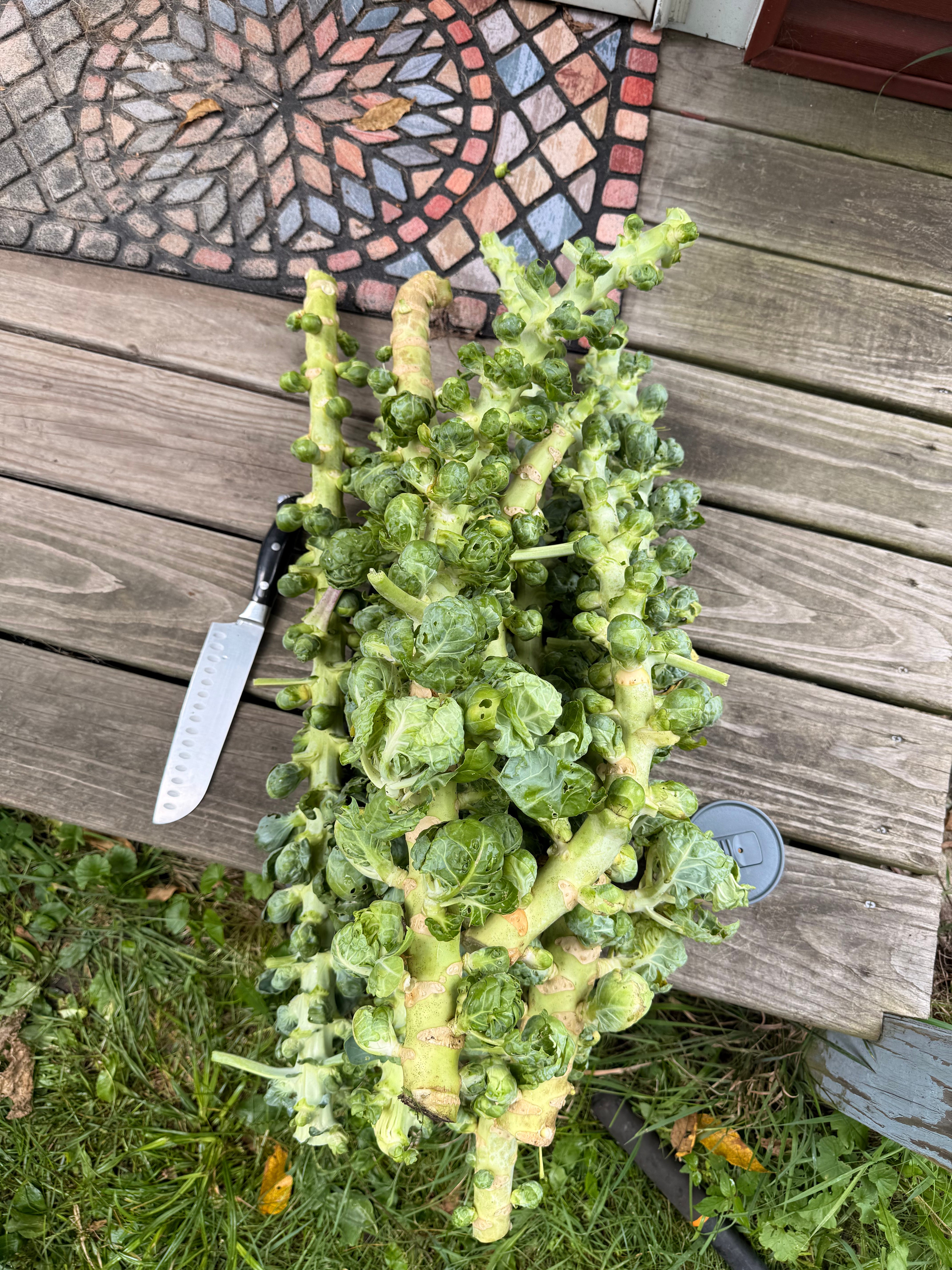
To be honest, it was not until last year when I grew them for the first time that I learned how bizarre this vegetable is in its becoming. My imagination betrayed, the small sprouts did not arrive as small cabbages dotting the soil. They were not like flowers unfurling from a sturdy tip, petals falling away to reveal a little sprout. Instead, they grew in the many crooks between stems and towering stalk. They grew as if carried. How one might cradle a child in one arm as the other hand is free to tend to the rest of the world.
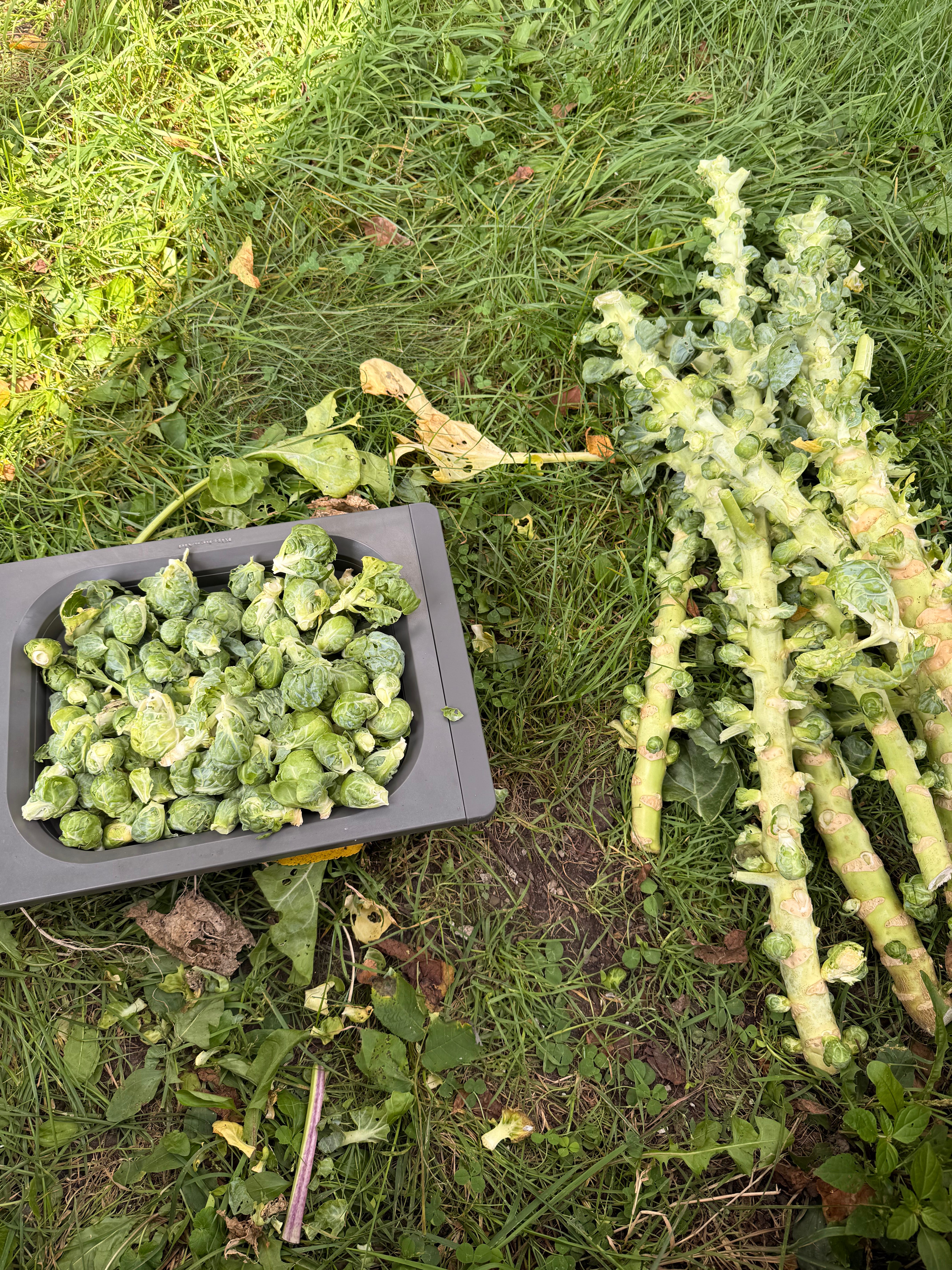
I piled the leafy stalks in the green wagon and sat myself down to do the work. Brussels sprouts are not quite a pluck-and-eat vegetable. Standing their stalks upright between my legs, I stripped off the leaves, leaving just the sprouts on the stalk. Closely examining the sprouts, I was pleased not to see frass in every fold and crevice. The sprouts, they were beautiful.
What are those? my husband asked at one point as I watered the Brussels sprouts. Unlike the cabbages and peppers, the sprouts were less obvious and more curious to behold. I used the hose’s nozzle to push a large leaf down to expose where its stem met the stalk, revealing a little nubbin of what looked like cabbage. A bunch of B.S., I said with a smile.
Maybe next year I’ll graduate to whetting a large knife that with one swift movement slices many sprouts from the stalk. This year, though, I sat with the stalks between my legs manually snapping the sprouts one at a time.
We are heave-and-ho. We are the hour and second hand. We flint and tinder, row and steer, weight and lever, rhythm and measure. The home we tend is older than the road that passes it. Its wooden bones even older. I run my finger along the galleries of tunnels on the old elm post that supports the ceiling in the basement. I don’t enter my basement to water my plants without thinking about the long-gone insects who created those tunnels. Through every wipe of the counter, every pinch of a butt cheek, every nap in the hammock, every bend over the stove top, every flick of a light switch, the land we dwell on and call our home crawls with possibilities, dramas, violence, theft, murder, prosperity, and their myriad reciprocities. From seed to blossom. From egg to final flap of fragile wings. A world is here, continuously providing, beginning, and ending.
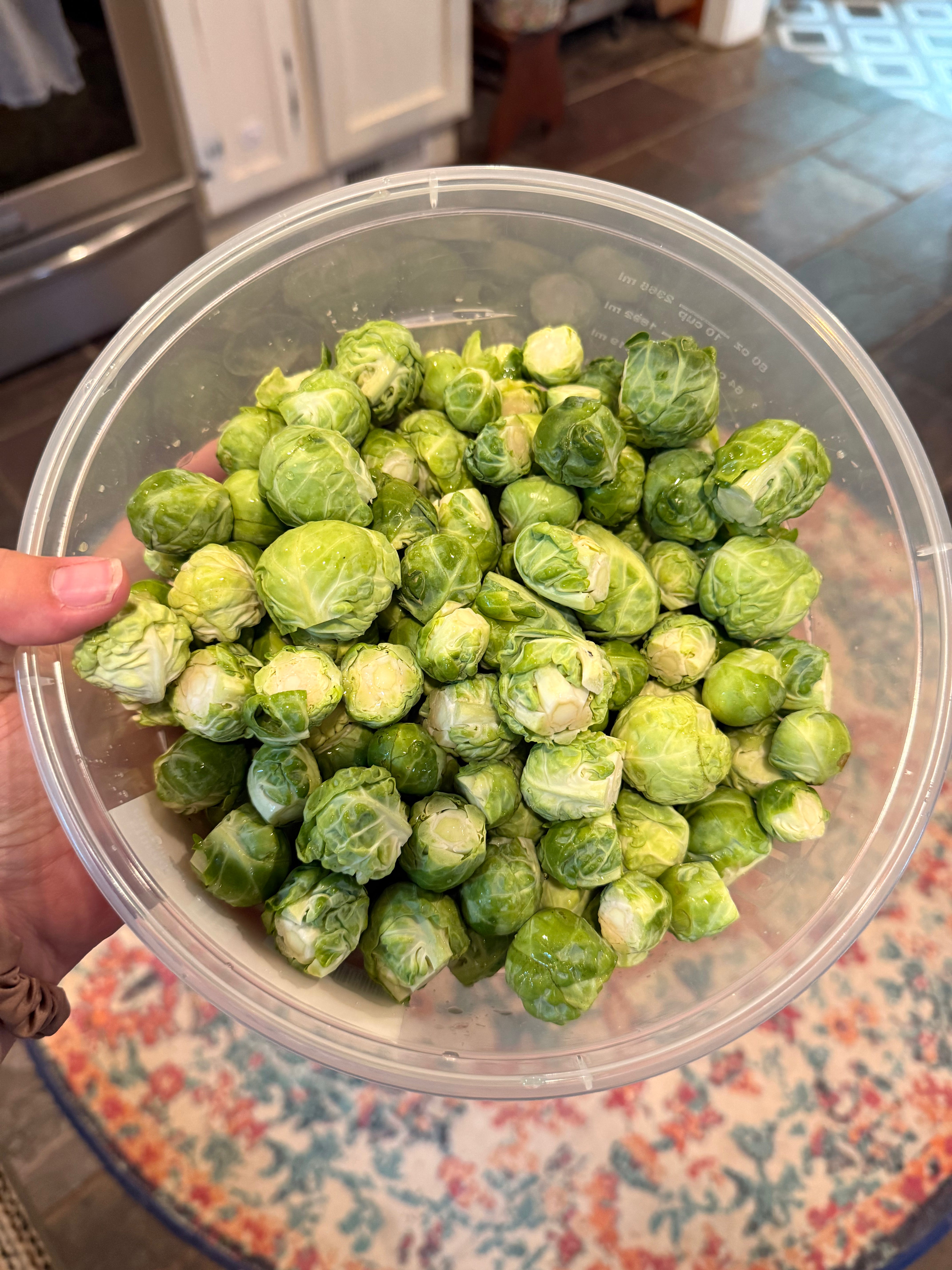
Later in the day, I finally got around to cutting each sprout and unsheathing them from their outer leaves. I stood in the kitchen yielding a knife, my back to the world as I sliced and revealed, sliced and revealed, until a bowl of beautiful sprouts became.
And while doing so, I became a little emotional as the pile of their discarded outer layers grew on the countertop. How amazing it is, I thought to myself, that everything we tend has its own narrative. I held up a sprout between my fingers. And how silly it is, I said to the sprout, that I wish I would have invited you to sit around the fire with us.
I’ll try growing them next year.I haven’t been able to grow broccoli or cabbage successfully.
Do the caterpillars of the white cabbage butterflies eat the Brussel sprouts?