

Suddenly I heard buzzing from the corner of the kitchen where I keep a little container for compost scraps on the counter. I turned from the fridge to look more closely and discovered a fly trapped in a strategic spider’s web. I hunched over the counter, resting my elbows, my chin resting in my hand as I watched the fly battle the web. I marveled at how such a tiny web could support such a display of struggle. Wondering where the spider was, I realized that what I thought was debris was actually the spider. I poked at the still, little creature and they moved. I imagined what that must be like, the muscle memory of vibration meaning feast. Just like me, the spider was watching the fly come to terms. I felt bad for the fly, valiant in their attempt to escape. I wanted to help them; there would be more victims in the web someday, surely. But I didn’t. Instead, I locked into what I’ve been journaling and reckoning with as of late: thinking vs. feeling. My body has been strapped to a narrative that volleys between depression, anxiety, and joy, always driven by the immensity of my feelings. I wanted to foster a balance between feeling & matter-of-fact. I continued watching the fly, their wings in a desperate buzz, until the fridge behind me beeped for me to shut its door.
*
It is the season of rot and bloodshed. Mushrooms melting into themselves like candles. Summer’s ignored roadside kill, just pouches of hide and bone. Jaw bones and teeth glistening in the early-evening moonlight. Opossums ruined on the roads, their pouches possible with babies. Many years ago, I pulled over and dug my fingers into a dead opossum’s pouch and discovered twelve still-living babies that I transported in my bike helmet to a rescue. It is the time of year where blood and body-splatter on the roads is absolutely normal and not horrific. When gore is just an obstacle to maneuver your wheels around. A deer in two pieces. A deer in three pieces. A deer without a head. A deer wrung and twisted like a wet cloth. We drive past ruined lives, narratives, and families like they’re pieces of broken furniture. And even if the bodies are scraped up and hauled away, the brown bloodstains blot the road like large teardrops, indicating acceleration and direction.
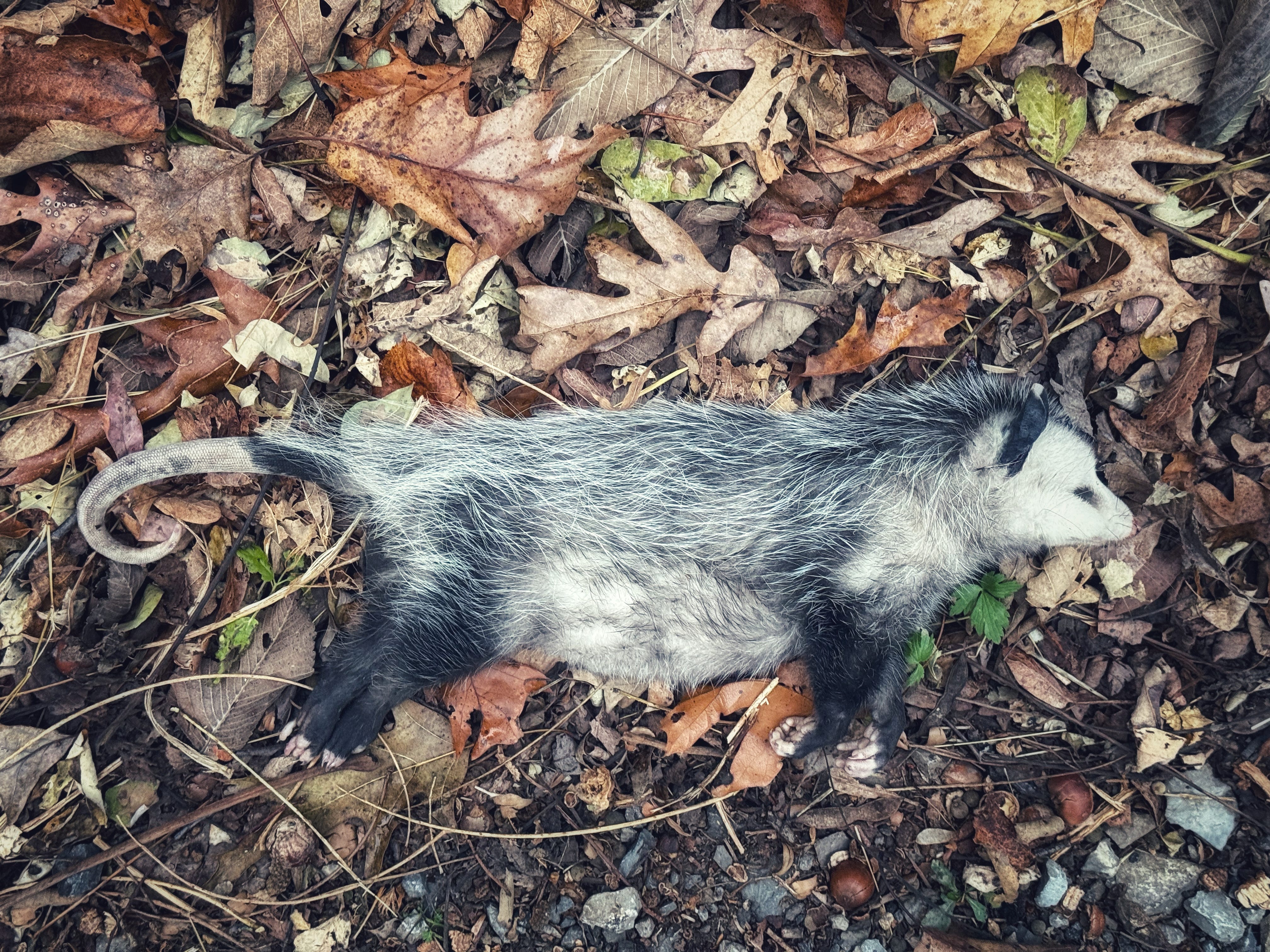
In early-morning darkness, driving the ridge-side interstate, I encounter a lot of gore on my way to work. This past week, the gore had me thinking about her body. Did she pass away in the kitchen? The living room? Near an exit where she had her hand on a doorknob for just a desperate moment? I thought about her dogs barking at her murderer or hiding somewhere in the house, away from the man who sometimes feeds them. The man who had been screaming and pummeling his wife to the ground. The man who applied his forearm to his wife’s throat, strangling her. The man who feared that he had murdered his own wife, couldn’t quite believe that to be fact, so he took a knife and provoked her dead body with it. The man who, while reckoning with his wife’s maybe-dead body, had been sending cryptic texts to his family who issued a police wellness check. He was found by police with blood on his hands.
While driving north on the interstate, I looked up at the ridge across the valley, toward the small town where she had been murdered. The small town where it takes 45 minutes for state police to respond. I thought about how as she was being murdered by her husband, I was at work at the mental health crisis center, possibly drinking coffee, reading through e-mails, or briefing my colleagues about various policy changes. As she came to terms, I sat there in my jeans, maybe laughing or going through my planner, or staring at the sky outside the window.
We all become just bodies. How quick we are to drive past torment, suffering, and mangle, chocking it up to just an animal. And how fascinating is distance. That torment and suffering and mangle is awful but it’s not here. How quickly the internet has trained our brains to spend seven seconds on a funny meme followed by seven seconds of a starving child in Gaza followed by seven seconds of ridiculous AI slop created to make us laugh followed by a seven second ad for a sweater that will change your life.
*
I might need to go to the emergency room my husband Brian said, explaining to me that his heart rate had been elevated all morning and all he had been doing was sitting in his office. He had been enduring illness for well over a year now. Hives or a rash had now covered most of his body the past few days. Already naturally thin, he had lost a lot of weight in a short period of time. Every hug or caress had me stiff with worry at how soft with atrophy his body had become. Encouraging high-calorie and high-nutrition intake was doing nothing. We had been reckoning with his unwellness for over a year.
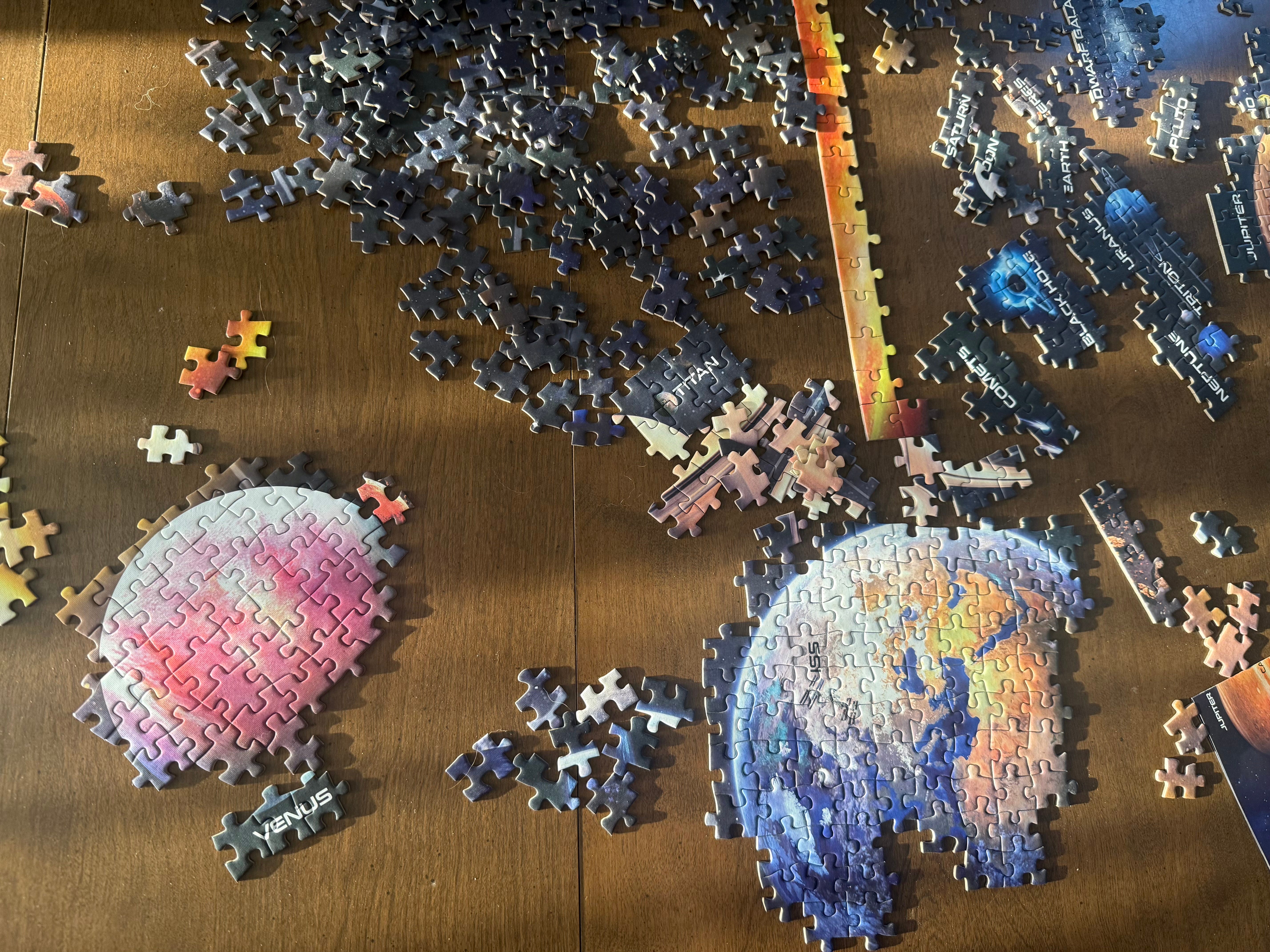
After agreeing to take him to the ER after his morning meetings for work were finished, I walked down the steps and sat at our dining room table. Worried, of course, I wanted to cry and let the emotional spiral begin. I wanted to desperately buzz my wings and torment myself in the web of what-ifs. It’s all a matter of energy and how to channel it. I could hear my mother saying Be strong for him. Allowing a healthy amount of emotion to arise isn’t a sign of weakness, of course. But spiraling downward didn’t feel productive or supportive for him or me. Instead, I stared at a solar system puzzle we had been building together at the dining room table. As always, I focused on the earth as he focused on space.
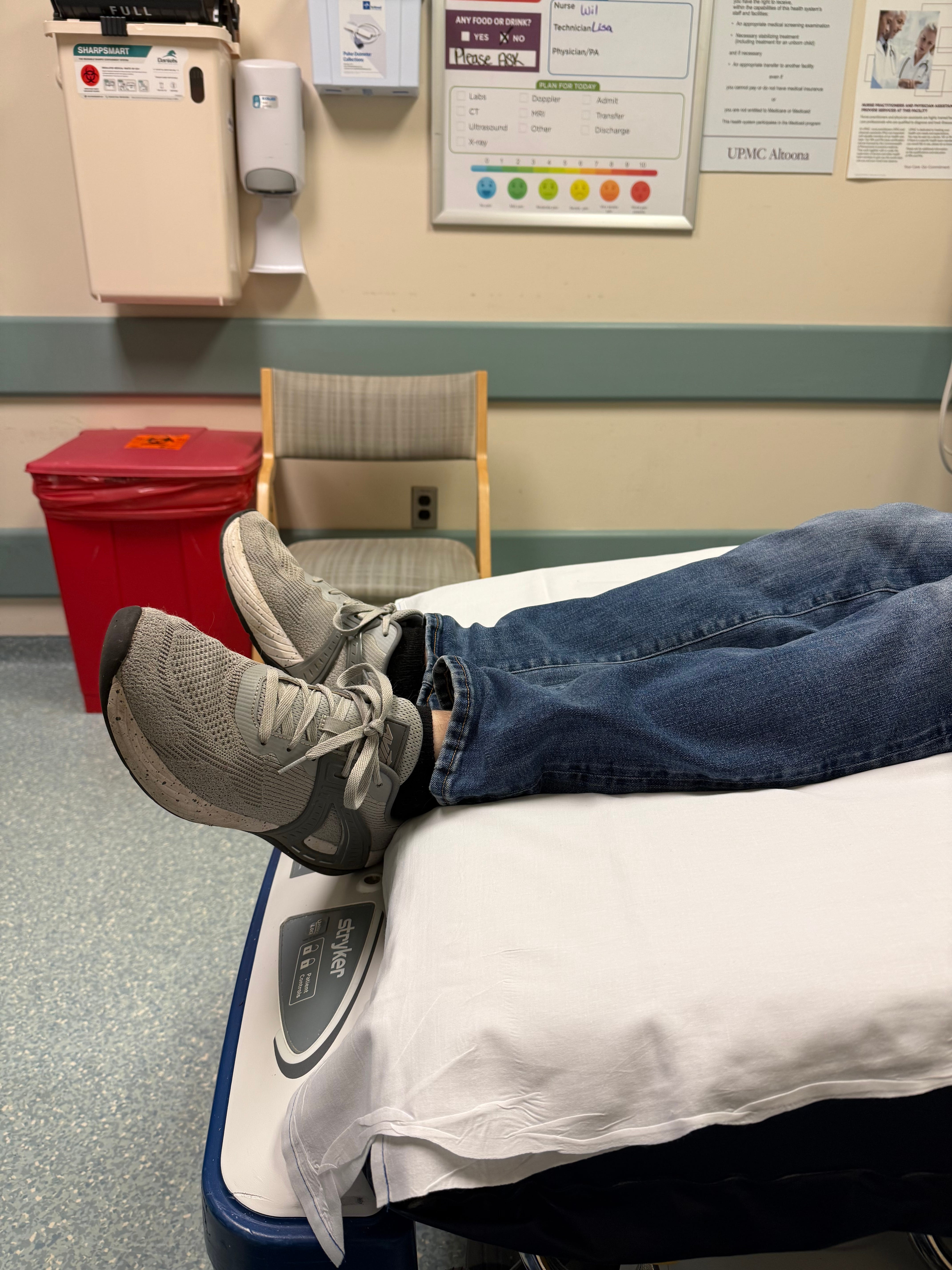
I sat with him in the evaluating room. I watched the doctor’s eyebrows raise as Brian performed the malady monologue, throwing in the buzz-words osteomyelitis and picc line. I contributed a little bit but mostly yeah and it was bad. He lifted his shirt to show the rash on his torso and back and I composed myself the best I could seeing his thinness under harsh lights, his ribs like stanzas. I still have the gauze pad another doctor handed me earlier this year after he casually mentioned that Brian could have died. The sky was bright and blue outside the window that day. People buzzed about on the sidewalks below. I wept into the gauze pad as Brian and his doctor jauntily talked about weather. At that point, he had been nearly healed from that turmoil.
In the ER, blood was drawn and Brian was given saline and fluids. The doctor tasked herself with trying to figure out skin rashes that relate to Brian’s current malady which I had already done on my end. Her conclusion was the same as mine. There is no rash that looks like that for his current diagnosis. More waiting. I looked at his body reclined on the bed. A body coveting an auto-immune disease. A body strapped to a life-long narrative of wellness and unwellness. While waiting for a CT scan to rule out other potential concerns, I thought about melting glaciers. How viruses are stored in deep layers of ice and if they melt, those viruses are released. I told Brian that maybe something had been stored in a layer of fat he no longer has and now his body is reckoning with it. But how would I know anything. I don’t.
Very prone to getting poison ivy rashes, I had the worst case of it a few years ago. Covering nearly my whole body, including my face, my skin was an exposed nerve. Clothing, couch fabric, everything was uncomfortable. Wearied by it, I decided to change my mind about it. Instead of annoyance and intolerance, I decided to be curious and marvel at it much like how I would marvel at lichen on a tree. I came to terms with my body, realizing that it was a host to fascinating bumps, fields of red skin, a sensitivity like no other. The rash rendered me a cartographer of my own body. Once healed, that awe and wonder continued. Months of steroids led to changes in my body. A swell here, excess there. I marveled at other bodies, too. The daringness of a unibrow. I celebrated the body being an ongoing narrative that even when the life-force is diminished, continues being a storytelling body.
D.H. Lawrence wrote I never saw a wild thing sorry for itself in his poem “Self-Pity”. While there are all kinds of studies and witnesses to animals lamenting and experiencing sadness and pain, I must say that there is a difference between the experience of pain and grief and the experience of resiliency that animals are forced to possess in their mechanism for survival. I’ve seen the lame-legged deer bound over a fence with its three stronger legs. I’ve seen numerous one-footed birds dip and swirl and scavenge for food. Birds without beaks. I’ve seen a few three-legged or partially-crushed turtles mosey along on the forest floors. But how would I know anything about their plight. I don’t. Who knows if this deer carcass or that bird carcass is a memento of simply giving up.
Discharged home, we settled into our evening. I fed the dogs who live in the constant now and certainly at least perform self-pity at not having been fed on time. So I fed them. I encouraged Brian to relax and eat. His heart rate had improved and he had an appointment with his physician the next morning. Mindlessly getting my dinner ready, I looked over to the corner of the kitchen where days ago I watched a fly struggle for their life. The lifeblood had been extracted from them and their shriveled, hollow body had been discarded from the web onto the countertop.